In December 2025, the Financial Conduct Authority (FCA) issued a Discussion Paper (DP25/3) seeking views on how its rules and regulatory framework could help build a stronger investment culture for consumers investing without an adviser. The FCA has now published its feedback statement (FS26/3) summarising the responses received and setting out how and when it plans to act on that feedback.
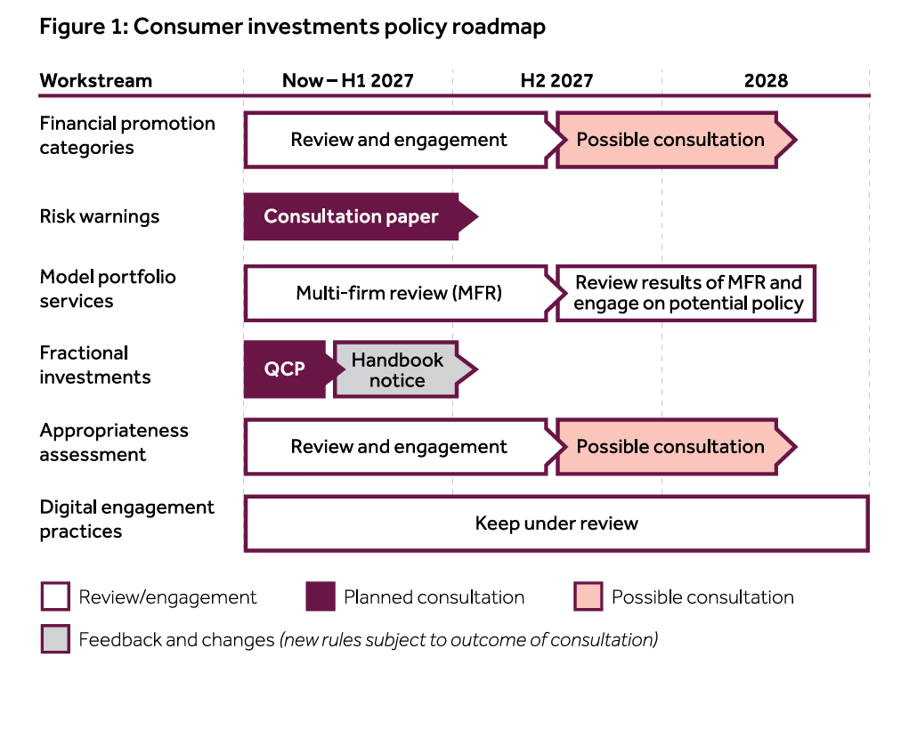
As part of the FCA’s Strategy, it would like to see an increase in consumers holding mainstream investments, meaning that it needs to provide support to make them accessible and appealing to investors. A number of reforms are therefore on the agenda in a sequenced way, starting with a review of the financial promotions rules for high-risk investments, followed by a consultation on rules and guidance around risk warnings, and finally commencing a review of how the appropriateness assessment works in practice.
Key messages and responses
Key messages and next steps highlighted in the FCA’s feedback statement include the following:
Self-certification is creating consumer harm: The Financial Promotions Order (FPO) contains exemptions that broadly allow unauthorised persons to promote equity and debt in unlisted companies to high-net-worth individuals and self-certified sophisticated investors, taking them outside of the FCA's rules, including the requirement for promotions to be clear, fair and not misleading. The FCA believes the current thresholds are outdated and too low (with the FCA noting that the thresholds do not align with the investable asset threshold on which the FCA has separately consulted as part of its proposed revisions to UK client categorisation / elective professional client opt-up criteria) and has seen evidence of consumers incorrectly self-certifying, leading to concerns that those who self-certify expect support or compensation when suffering losses that a sophisticated investor might have anticipated.
Legislative change is required to reduce the number of consumers being inappropriately opted out of protections, whether through raising the level of the thresholds, removing self-certification or removing the exemptions in their current form: Maintaining the status quo would mean that these harm continue, leaving consumers susceptible to potentially misleading promotions and inappropriate investments, with few routes for recourse. The FCA considers legislative change is necessary and will continue engaging with HM Treasury.
Financial promotion categories are inconsistently applied and too broad: Most respondents said the current categories are inconsistently applied, too prescriptive and too broad. Some feedback in this area indicated that the prescriptive nature of requirements is inconsistent with the high-level nature of the consumer understanding and outcomes principles in the Consumer Duty rules. The FCA will begin to review its high-risk investment categorisation, working with stakeholders to assess the harm caused by current inconsistencies, what alternatives would look like and whether and why they could lead to better outcomes.
FCA rules treat some speculative products inconsistently: Contracts for Differences (CFDs) are subject to product-specific promotion and distribution rules in COBS 22, such as leverage limits and negative balance protections, reflecting the risks of leverage, short-term trading and complexity, whereas Leveraged Exchange-Traded Products (ETPs), which track the performance of underlying assets and amplify gains and losses, have daily resetting periods and are designed for short-term trading, but are not subject to the same requirements. The FCA considers the risks of gambling-like products to be different from investment risk but will keep its regulatory framework under review as products develop that exploit gambling-like behaviours.
Consumer harm is resulting from the use of Digital Engagement Practices (DEPs) in combination with demand for speculative products: Respondents reported that DEPs such as copy trading, push notifications, rewards-based nudges and social comparison features such as trader leaderboards can make the underlying value proposition of speculative products less transparent and more confusing for consumers. Copy-trading is particularly harmful, as consumers have the impression it is a simple and safe way to invest when in fact it can expose them to speculative products they do not fully understand.
Fractional shares must be clearly distinguished from buying derivatives: Respondents were generally positive on the availability of fractional shares but stressed the importance of distinguishing them from derivative-based products, which have different risks and protections. Respondents recommended that, if a fractional share is structured so that its risks are similar to those of the underlying share, the fractional share should be equally accessible, and that it should be clear to consumers what structure they are buying and who the issuer is. In September 2026 under CP26/32, the FCA consulted on the application of its rules to fractional shares based on their risk profile but confirmed it does not consider derivatives to be the same as fractional shares, and that exposure offered via a derivative is riskier than acquiring an interest in a whole share, for which stricter safeguards are required.
Risk warnings are ineffective: The feedback received reflects that risk warnings are broadly applied by firms out of caution; place too much emphasis on volatility and capital loss rather than the potential rewards of investing; and consumers encounter the same or similar warnings repeatedly. This means that even for mainstream and suitable products, consumers may overestimate the risks of investing. The FCA plan to consult further on its rules and guidance around risk information in financial promotions of mainstream investments in its Review of Financial Promotion Rules for Mainstream Investments in H1 2027, along with consumer research to support its proposals.
Pre-sale product and service communications: Following the customer journey after financial promotions have been made, the FCA refers to its reforms to improve product disclosures for packaged products through the new CCI regime (which will fully enter into force in June 2027) and to its on Simplifying Consumer Investment Disclosures (CP26/24) (on which final rules are due by the end of 2026).
Model Portfolio Services (MPS) are under active multi-firm review scrutiny: Respondents broadly agreed that multi-client managed MPS are understood from a consumer perspective as off-the-shelf investment propositions akin to packaged products, and that aligning model portfolio disclosures with the CCI regime would promote consistency and consumer understanding when choosing between multi-asset funds and multi-client managed MPS. The FCA has begun a multi-firm review on how firms manufacturing MPS are achieving good outcomes for consumers under their Consumer Duty obligations. This will assess portfolio construction, asset selection, risk ratings, management of conflicts of interest, rebalancing practices and oversight structures, with findings expected in Q1 2027.
Appropriateness assessments need reform and clarification: Most respondents support the concept of appropriateness assessments but called for reform and clarification, with the "non-complex" definition in COBS 10 and COBS 10A, derived from EU law, repeatedly noted as a challenge, with the definition being applied inconsistently, sometimes not applied where necessary and sometimes applied too stringently. The FCA will take forward a review to deepen its understanding of how this stage of the consumer journey works in practice and explore whether and how changes could promote better consumer outcomes, with this work informing any policy proposals taken forward.
FCA feedback statement (FS26/3) on ‘Expanding consumer access to investments: Feedback to DP25/3’ published on 16 October 2026, is available here.